Car Rental Without Hidden Fees: Compare Worldwide Offers Today
Car Rental Without Hidden Fees: Compare Worldwide Offers Today
Car rental worldwide looks simple on the surface, yet the distance between the number on a comparison screen and the amount on your final invoice can be large enough to reshape an entire trip budget. Rental Car For You is an independent comparison service focused on rental cars for travelers, with particular attention to Cyprus, where airport pickups, local providers and international brands all compete for the same customers. This article expands on the core findings of the parent piece, which argued that headline daily rates are built to win the click while the contract is built to recover operating costs. The practical task is to build a true all-in baseline, compare offers on identical terms, and verify that the invoice you sign at the counter matches the quote you accepted online. Learn more about how the original analysis framed this gap between advertised and final prices.

Why the Quoted Daily Rate Misleads
The advertised daily rate is usually the cheapest possible version of a rental: a basic car, minimal insurance, a standard fuel policy and a pickup location that the provider does not have to pay extra to serve. Every addition beyond that point is typically a separate line item with its own logic, and once you understand that logic, the invoice stops looking arbitrary. A useful starting point is to define the all-in figure as the base rate plus mandatory taxes, location surcharges, insurance you will actually carry and any fees triggered by your itinerary. Comparing only the daily rate across aggregators produces false rankings, because two offers with identical headline prices can diverge sharply once a required insurance level, a fuel policy or an airport surcharge is applied.
Used this way, the comparison is less about finding the lowest headline price and more about securing a booking whose invoice matches what you agreed to pay
Mandatory charges that surface only at checkout deserve particular scrutiny. Operators at airports commonly pass on concession recovery fees paid to the airport authority, and these are rarely folded into the advertised rate because they depend on the terminal rather than on the operator's own decisions. A car collected at a city branch in Nicosia or Larnaca may therefore look far cheaper than the same model collected at the terminal, even though the vehicle and the contract are identical. Local value-added tax is a second source of divergence: some aggregator pages show prices before tax by default, so an offer that appears roughly fifteen to twenty percent cheaper may simply be displaying a net figure. Registration or environmental recovery fees, which vary by country, add a further layer. Checking whether a quote states that taxes and fees are included is the fastest way to avoid comparing a gross price with a net one.
Setting up a comparison template solves most of these inconsistencies. Fix identical parameters before opening any quote: the same pickup and return locations, the same dates and times, the same driver age, the same car class and the same mileage allowance. Then record every line item in a single sheet, including base rate, taxes, airport or station surcharges, insurance, deposit type, fuel policy and any optional extras. Offers compared on this basis reveal their real ranking, and the sheet itself becomes the reference you check against the counter contract later.
What You Need Before Comparing Offers
Driver and licence requirements change the price as much as the car does. Many providers require an international driving permit for licences not issued in the Latin alphabet or in a country with a recognised agreement, and enforcement at the counter varies, so confirm the requirement with the specific operator rather than assuming it does not apply. Minimum and maximum age rules come with surcharge bands: drivers below a certain age and senior drivers above another threshold are commonly charged a daily premium, and these bands are calculated separately from the base rate. Licence-held duration is a third filter, since some companies exclude drivers who have held a licence for fewer than a set number of years, or price them into a higher tier. Establishing your eligibility before comparing prices prevents you from building a shortlist that you cannot legally or contractually book.
Itinerary variables shift the total in ways that are easy to miss. A one-way rental, such as picking up at Paphos airport and dropping off in Limassol, usually carries a fixed or distance-based drop-off charge, while a round trip avoids it entirely. Cross-border drop-offs are restricted or surcharged by many operators, so any route beyond the island's own jurisdiction must be checked explicitly. Rental length also creates breakpoints: a weekly rate is frequently cheaper per day than a short rental, and in some cases a rental of six days costs more than seven, so it pays to test adjacent durations before choosing. Mileage policy is the final itinerary variable. An unlimited-mileage contract removes the risk of overage charges, while a capped contract with a per-kilometre fee can turn a long coastal loop into an unexpectedly expensive trip.
Payment method and deposit mechanics complete the preparation stage. Some operators require a credit card in the main driver's name, while others accept debit cards and prepaid cards under stricter verification. The security deposit is usually a hold rather than a charge, reducing the available balance on the card without transferring money, and the hold is released after the vehicle is checked on return. The distinction matters at pickup, because a hold that exceeds your available credit can block the rental even when the booking is confirmed. Confirm the deposit amount in writing and check whether the operator pre-authorises it or actually charges it.
Step-by-Step Comparison Workflow
Running parallel quotes is most effective when you collect them from three source types: direct brand websites, local independent operators and aggregators. Use the same template for every source and re-check each quote after entering exact pickup and return times, because some providers adjust fees for out-of-hours collection or for returns outside office hours. Quotes gathered in a single session often diverge once the times are fixed, and the divergence is usually in the surcharge lines rather than in the base rate. Rental Car For You lets you filter offers by deposit, insurance, mileage and payment options and compare local and international providers side by side, which is useful at this stage because the filters remove unsuitable offers before you spend time on prices.
Reading the rental agreement before booking is the step most travelers skip, and it is where the expensive surprises sit. Locate the sections covering insurance excess, fuel policy, late return charges and additional driver fees, and note whether each is included by default or sold at the counter. Pay particular attention to exclusions: many contracts forbid unpaved roads, certain vehicle categories, specific border crossings or travel on islands connected by ferry. A car that suits your planned route on paper may be legally unavailable for the roads you actually intend to drive. If the terms are ambiguous, ask the operator to confirm the answer in writing before you pay. Before booking, it helps to compare the full price with airport surcharges, insurance terms and fuel policies, and a neutral overview of how these charges are usually listed can be found at Learn more.
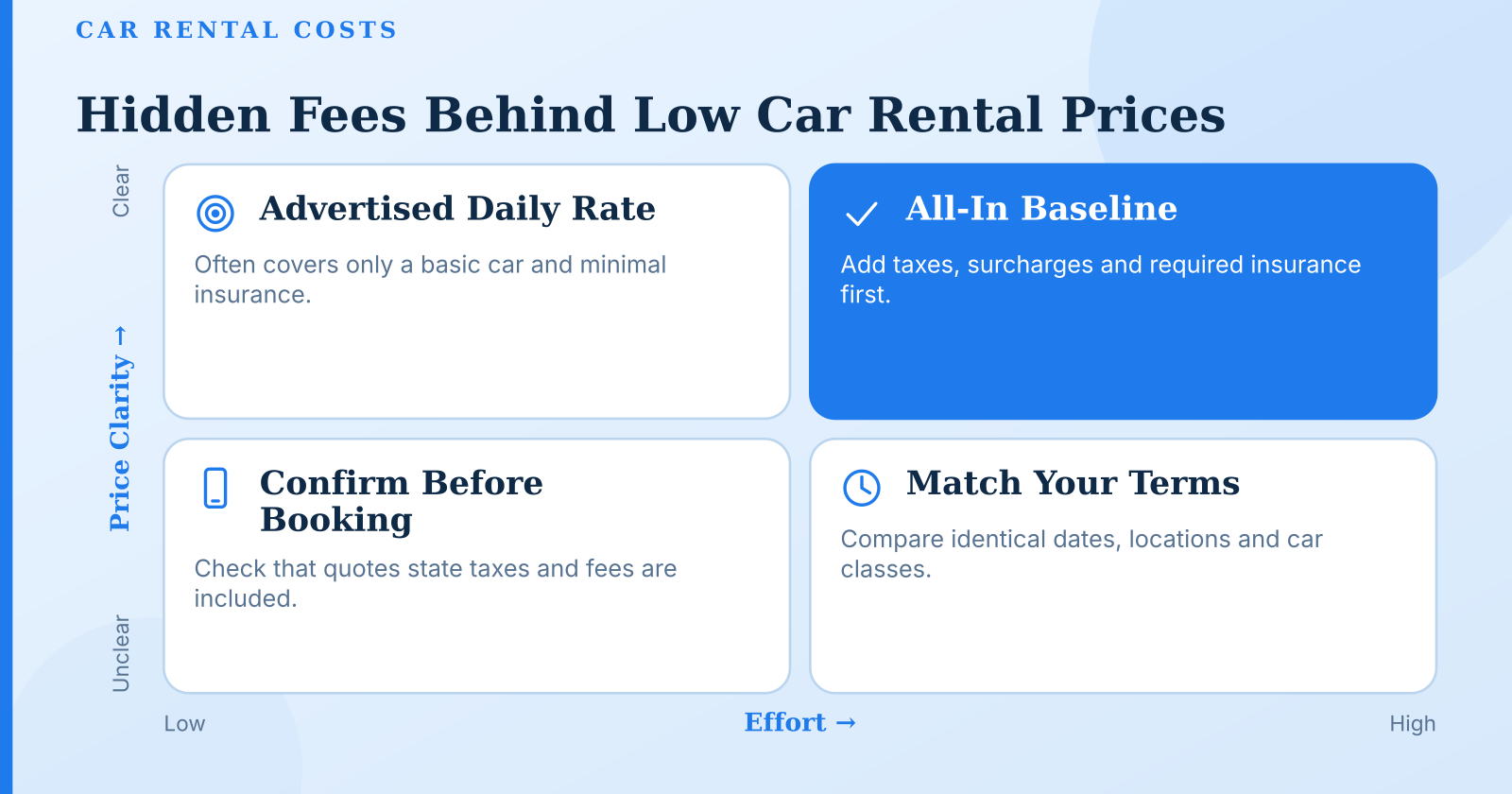
Verifying the quote against the final invoice closes the loop. Cross-check the booked total against the pre-pickup confirmation email, then reconcile the counter contract against the original quote line by line before signing. Any new line that did not appear in the confirmation, such as an added airport surcharge, a fuel premium or an insurance upgrade, should be questioned on the spot and either removed or documented with the staff member's name. Keeping the confirmation, the comparison sheet and the signed contract together gives you a clear record if a dispute arises after return.
Insurance Excess, Fuel and Damage: Where Costs Hide
Basic rental agreements typically include third-party liability, which covers damage to other people's property and vehicles, but leave the rented car itself exposed. Operators sell collision damage waiver and theft protection as optional or semi-mandatory add-ons, and the key figure within those products is the excess, also called the deductible. The excess is the amount you are liable for if damage occurs even when you hold a waiver, and in some markets it can approach the full value of the vehicle. A reduced-excess add-on lowers that liability but adds a daily cost, so the correct comparison is the total cost of the rental with each excess level, not the premium alone. Ask for the excess figure in writing and check how it is held on the card and released after return, since the release timing depends on the issuing bank.
Fuel policies are the most common source of avoidable cost. A full-to-full policy means you collect the car with a full tank and return it full, which is generally the cheapest option if you refuel close to the drop-off point. A pre-purchase fuel policy sells you a full tank at a rate that is often above local pump prices, and you receive no refund for fuel left in the tank. A pay-on-return policy charges a premium per litre to refill the car for you, sometimes several times the local price. To evaluate these, check the current local station price near your return location and calculate the premium per litre against it, so the decision rests on numbers rather than on the convenience the operator is selling.
Damage assessment and documentation protect you on both ends of the rental. Take dated photos and short video of the exterior, interior, wheels, windscreen and odometer at pickup, and repeat the process at drop-off with the fuel gauge visible. Note any existing marks on the rental agreement before you leave the lot, because undocumented damage is the usual basis for disputed charges. Read how tyre, glass and underbody damage are treated in the contract, since many standard waivers exclude these, and a reduced-excess product may still leave them uncovered.
Checklist: Selecting the Lowest True-Cost Offer
- Confirm the all-in total includes taxes, mandatory surcharges and the insurance level you will actually use, not only the headline daily rate.
- Compare the excess, fuel policy and deposit type across offers, since these often outweigh a small difference in the base rate.
- Calculate the fuel premium per litre against a local station price near your return point before choosing a pre-purchase or pay-on-return option.
- Check mileage limits, overage fees and cross-border or ferry restrictions against your planned route.
- Verify driver eligibility, including licence-held duration, age surcharge bands and any international driving permit requirement.
- Confirm the deposit amount and whether it is a hold or a charge, and make sure your available credit covers it at pickup.
- Document the vehicle with dated photos and video at pickup and drop-off, and keep the confirmation with the signed contract.
The cheapest quote is only the cheapest when every other variable is held constant. Comparing excess, fuel policy and deposit with the same care given to the daily rate shows which offer actually costs less for your itinerary, and reconciling the counter contract against the original quote protects that result. For travelers renting in Cyprus, where airport and city prices, local and international providers, and one-way routes all affect the final figure, the disciplined approach is to build the all-in baseline first and only then choose.


Комментарии
Отправить комментарий